|
ALMANACH
DE SAXE GOTHA Societe
des Amis de l' Almanach de Saxe Gotha Welcome - Willkommen - Bienvenue - Benvenuti Official
Website of the Almanach de Saxe Gotha Online Royal Genealogical Reference Handbook Saxe Gotha Genealogisches Handbuch des Adels
"A
monarchy conducted with infinite wisdom and infinite benevolence is the most perfect of all possible governments, for if the
Allies at the peace table at Versailles had allowed a Hohenzollern, a Wittelsbach and a Habsburg to return to their thrones,
there would have been no Hitler. A democratic basis of society might have been preserved by a crowned Weimar in contact with
the victorious Allies" Volume
- I Encompasses and Lists the Genealogy
of the Imperial and Royal Sovereign Houses and Families Reigning and Formerly Reigning in Europe and South America
Volume - II The
Mediatized Sovereign Houses of the Holy Roman Empire of the German Nation Encompasses and lists the genealogy of the Mediatised Sovereign Houses of the Holy Roman Empire of the German Nation Volume - III Encompasses and lists the Genealogy
of The Non-Sovereign Princely and
Ducal Houses and Families of Europe Volume - IV The Nobility of the Holy Roman Empire Encompasses and Lists the Imperial Nobility of Holy Roman Empire of the German Nation Register of the Nobility of the
Holy Roman Empire. Volume - V The British Peerage System Gotha Index to the British Peerage System, the formal listing of the Titles, Ranks, Styles, Title Holders and their Heirs, the Date of Creation and the Present Status of the Peerage listed (I): Dukes - Marquesses - Earls (II): Viscounts Encompasses
the History and lists
the Genealogy of the Royal Houses
and Families of the World - 2025 Encompasses
and lists the Genealogy
of The Gotha Higher Nobility of
Europe to the present day - I-XVI Index of the Nobility
of the World, the
History and Register of Nobility and the formal listing of the Titles, and Ranks of Nobility in the World. Monarchs Net Worth
Listing of the
World's Richest Monarchs in order of wealth, the figures are calculated based upon their present assets as Sovereigns of the Realm. Index of Titles - Styles -
Ranks Index of European Royal and Noble
Titles, Styles, Honours
and Formal Appellations. Index of Abbreviations of International
Royal and Noble Titles, Styles and Chivalric, Military, Diplomatic and Academic Ranks. Royal Websites - Birthday Calendar Link Gateway to the official websites of European Royal
Houses and Families Lists the Birthdays of various members of the Royal Families of the World Lists many famous quotations
on the subject and support of Monarchy
Web Links Dictories - 2025 Articles of
Interest Section - 2025 Hohenberg
History, Genealogy and Pictures. History,
Life, Marriage and Pictures. History,
Life, Marriage and Pictures. Parents and Birth,
born 22 July 2013 History
of the Almanach de Gotha from its creation in 1763 to its end in 1944. Gallery
of picture bookplates of the old Almanach de Gotha from 1790 to 1940. History
of the Mughal Empire and the Emperors from its creation to its end. Lists
the Early Kings of Sweden, Norway and Denmark, by Name and Date. The Association
and History of the Arundell Counts of the Holy Roman Empire.
Chivalric Orders of Knighthood
Listing
the Chivlaric Orders of the World and Europe from Monarchical and Dynastical Orders to Papal Orders of Knighthood The
Monarchies of the World A monarchy is a form of government in which sovereignty is actually or nominally embodied
in a single individual the monarch, there are currently 44 or so Nations in the World with a Monarch as their Head of State,
they fall into the following six categories which are listed below for reference.
I - Commonwealth Realms: Sixteen
Commonwealth realms (Antigua and Barbuda, Australia, Bahamas, Barbados, Belize, Canada, Grenada, Jamaica, New Zealand, Papua
New Guinea, Saint Kitts and Nevis, Saint Lucia, Saint Vincent and the Grenadines, Solomon Islands, Tuvalu and United Kingdom
of Great Britain and Northern Ireland) all share Queen Elizabeth II as monarch in a personal union arrangement. They all share
a common British inheritance and have evolved out of the British Empire into membership of the Commonwealth of Nations as
fully independent states where they retain Queen Elizabeth as head of state; unlike other members of the Commonwealth of Nations
which are either dependencies, republics or have a different royal house. All sixteen realms are constitutional monarchies
and full democracies where the queen has limited powers or a largely ceremonial role. The queen is head of the established
Protestant Christian Church of England in the United Kingdom however, the other monarchies do not have an established church. II - Other European Constitutional Monarchies: Andorra, Belgium, Denmark, Luxembourg, Netherlands, Norway,
Spain, and Sweden are fully democratic states in which the monarch has a limited or largely ceremonial role. There is generally
a Christian religion established as the official church in each of these countries. This is a form of Protestantism in Norway,
Sweden, Denmark, and the Netherlands, while Belgium, Luxembourg, and Andorra are Roman Catholic countries. Spain has no official
State religion. Andorra is unique among these monarchies, as it is, by definition, a diarchy, with the Co-Princeship being
shared by the President of France and the Bishop of Urgell. This situation, based on historic precedence, has created a unique
situation among monarchies, as both Co-Princes are not of Andorran descent, and one is elected by common citizens (of France,
however, as Andorrans cannot vote in the French Presidential Elections). III - European Constitutional: Absolute Monarchies: Liechtenstein and Monaco are constitutional monarchies in which the
Prince retains many powers of an absolute monarch. For example the 2003 Constitution referendum which gives the Prince of
Liechtenstein the power to veto any law that the Landtag proposes and the Landtag can veto any law that the Prince tries to
pass. The Prince can hire or dismiss any elective member or government employee from his or her post. However what makes him
not an absolute monarchy is that the people can call for a referendum to end the monarchy's reign. The Prince of Monaco has
simpler powers but can not hire or dismiss any elective member or government employee from his or her post, but he can elect
the minister of state, government council and judges. Both Albert II and Hans-Adam II have quite a bit of political power,
but they also own huge tracts of land and are shareholders in many companies. 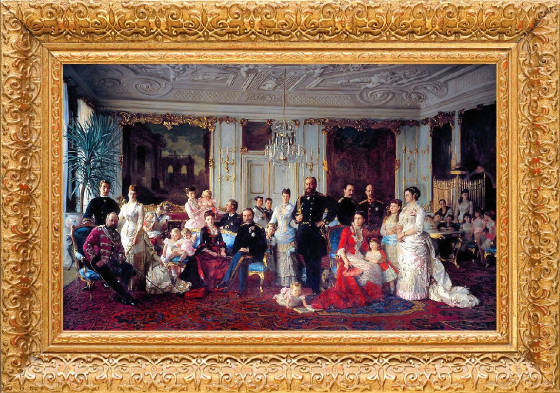
IV - Islamic Monarchies: Islamic monarchs of Bahrain, Brunei, Jordan, Kuwait, Malaysia,
Morocco, Oman, Qatar, Saudi Arabia, and the United Arab Emirates generally retain far more powers than their European or Commonwealth
counterparts. Brunei, Oman, Qatar, and Saudi Arabia remain absolute monarchies; Bahrain, Kuwait and United Arab Emirates are
classified as mixed, meaning there are representative bodies of some kind, but the monarch retains most of his powers. Jordan,
Malaysia and Morocco are constitutional monarchies, but their monarchs still retain more substantial powers than European
equivalents. Malaysia could also be considered as an East Asian constitutional monarchy. V - East Asian Constitutional Monarchies: Bhutan, Cambodia, Japan, Thailand have constitutional monarchies where the monarch has a
limited or ceremonial role. Bhutan, Japan, and Thailand are countries that were never colonised by European powers, but have
changed from traditional absolute monarchies into constitutional
ones during the twentieth century. Cambodia had its
own monarchy after independence from France, which was deposed after the Khmer Rouge came into power and the subsequent invasion
by Vietnam. The monarchy was subsequently restored in the peace agreement of 1993. Shintoism and Mahayana Buddhism are the
established religion in Japan, while Bhutan, Cambodia and Thailand are all Theravada Buddhist countries. However, most Japanese
people practice Buddhism and Shinto simultaneously. VI - Other Monarchies: Five
monarchies do not fit into one of the above groups by virtue of geography or class of monarchy: Tonga and Samoa in Polynesia;
Swaziland and Lesotho in Africa; and the Vatican City in Europe. Of these, Lesotho and Tonga are constitutional monarchies,
while Swaziland and Vatican City are absolute monarchies. Samoa falls into neither class, as one of the Four Paramount Chiefs
of the country is elected to hold the position of O le Ao o le Malo, or "Chieftain of the Government". This position
is not required by the Samoan constitution, which is why Samoa is officially classified as a republic rather than a constitutional
monarchy. Swaziland is also unique among these monarchies, often being considered a diarchy. The King, or Ngwenyama, rules
alongside his mother, the Ndlovukati, as dual heads of state originally designed to be checks on political power. The Ngwenyama,
however, is considered the administrative head of state, while the Ndlovukati is considered the spiritual and national head
of state, a position which more or less has become symbolic in recent years. The Pope is monarch of Vatican City by virtue
of his position as head of the Catholic Church; he is an elected rather than hereditary ruler. The History and Creation of the Duchy
of Saxe-Coburg and Gotha
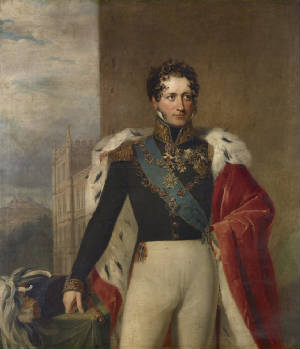
Duke
Ernst I - 1826-1844 The two duchies of Saxe-Coburg and Saxe-Gotha originated
in the division of the ancestral estates of Duke Ernest the Pious (d. 1675), the founder of all the Saxon ducal lines (except
the grand-ducal line of Saxe-Weimar-Eisenach), among his seven sons. With Duke Frederick IV, who had become a Catholic at
Rome in 1807, the line of Saxe-Gotha became extinct (1821), and, after long disputes concerning the succession, the territory
of Gotha fell to the line of Coburg-Saalfeld in 1826, were among the Saxon duchies held by the Ernestine branch of the Wettin
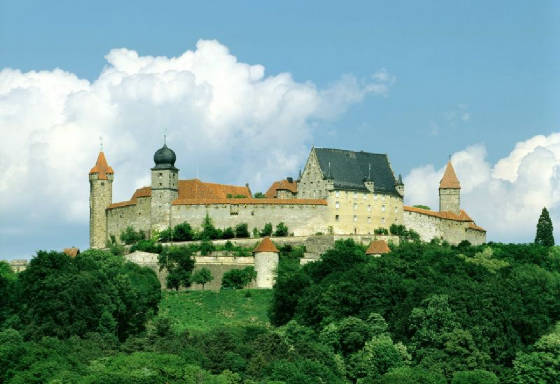
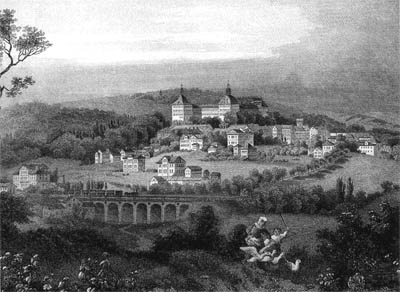
dynasty. Coburg
Castle The duchy of Saxe-Coburg
and Gotha originated as the personal union of these two duchies in 1826, after the death of the last Duke of Saxe-Gotha-Altenburg,
who died without male heirs. His Wettin relations repartitioned his lands. The former husband of Louise of Saxe-Gotha-Altenburg,
the only niece of the last duke, was Duke Ernest III of Saxe-Coburg-Saalfeld. He received Gotha and changed his name and title
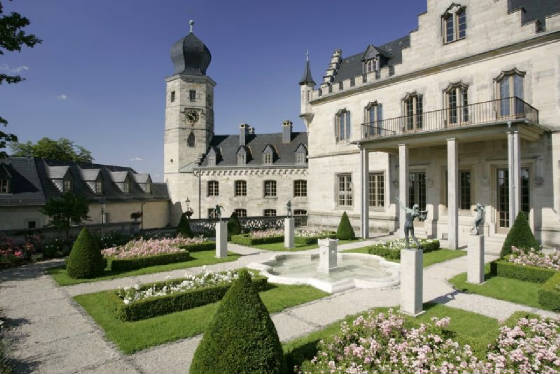
to Ernest I, Duke of Saxe-Coburg and Gotha although, technically, the two duchies remained as separate duchies. Schloss
Rosenau in Coburg Many members of the ruling
house of Saxe-Coburg-Gotha ascended the thrones of several European countries during the nineteenth century. By his marriage
with Queen Victoria (1840), Prince Albert became the founder of the present royal house of England; Prince Leopold was elected
hereditary King of Belgium in 1831, the Belgian branch of the House of Saxe-Coburg becoming Roman Catholic. Prince
Ferdinand of Saxe-Coburg-Gotha-Koháry The line of the House of Saxe-Coburg-Kohary, founded through the marriage of Prince Ferdinand with the heiress of
the Hungarian princely House of Kohary (1816), is also Roman Catholic. A son of this marriage, Ferdinand, was the founder
(1837) of the dynasty which ruled in Portugal until 1910; a grandson, also named Ferdinand, became in 1887 hereditary Prince,
and in 1909 King (Tsar) of Bulgaria. In the Duchy of Saxe-Coburg and Gotha the main line became extinct in 1893, the succession
falling to the English branch; Duke Charles Edward (b. 1884), son of the Duke of Albany and grandson of the Prince Consort
Albert and Queen Victoria, has reigned since 1899 (until 1905 under a guardian). Duke
Ernst II - 1844-1893 Duke Ernst I died in 1844.
His elder son and successor, Ernest II, ruled until his own death in 1893. As he died childless, the throne of the duchies
would have passed to the male descendants of Ernst's late brother Albert, the Prince Consort, husband of Queen Victoria of
the United Kingdom. However, the constitutions of both duchies excluded the British heir apparent from the ducal thrones if
there were other eligible male heirs, although Albert Edward, Prince of Wales had already renounced his claim to the ducal
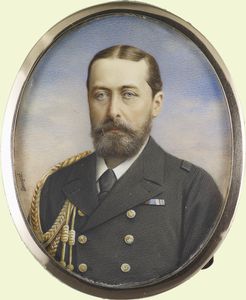
throne in favour of his next brother, Prince Alfred, Duke of Edinburgh. Duke
Alfred - 1893-1900 Alfred's only son, also named
Alfred, committed suicide in 1899, so when Duke Alfred died in 1900, he was succeeded by his nephew the Duke of Albany, the
sixteen-year-old son of Queen Victoria's youngest son, Leopold. Alfred's next brother Prince Arthur, Duke of Connaught and
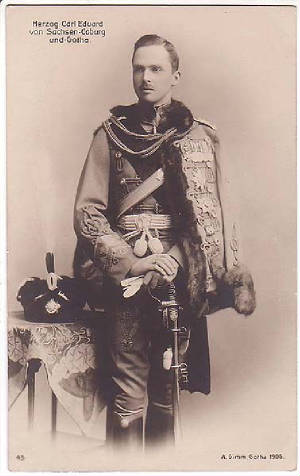
his son Prince Arthur of Connaught having renounced the succession. Reigning as Duke Carl Eduard, or Charles Edward, under
the regency of the Hereditary Prince of Hohenlohe-Langenburg until he came of age in 1905, the new duke also continued to
use his British title, Duke of Albany. As a result of Charles Edward fighting for Germany against the British in the First
World War, he was stripped of his British titles in 1919. Duke
Carl Eduard - 1900-1918 Charles Edward reigned until
November 18, 1918 during the German Revolution, when the Workers' and Soldiers' Council of Gotha deposed him. The two Duchies,
now without a common ruler, became separate states until shortly thereafter, when they ceased to exist. Saxe-Coburg became
a part of Bavaria and Saxe-Gotha merged with other small states in 1920 to form the new state of Thuringia in the Weimar Republic. Friedenstein
Castle in Gotha The capitals of Duchy were
Coburg and Gotha, the Duchy had an area of 751 sq. miles made up of the two chief divisions, the Duchy of Coburg (216 sq.
miles) and the Duchy of Gotha (541 sq. miles), these divisions are separated from each other by a portion of Saxe-Meiningen
and a strip of land belonging to Prussia (Kreis Schleusingen).
In 1910 the territory had 257,208 inhabitants; in 1905
its population of 242,432 included 3897 Catholics (2 per cent), 237,187 Evangelicals, and 714 Jews. The two duchies were united
in 1826 but each territory has still its own constitution, diet, and internal administration, even as regards religion and
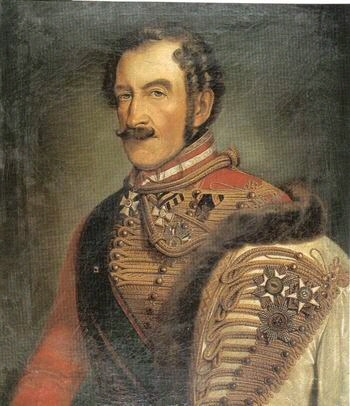
education. Ernst
I - Duke of Saxe-Coburg and Gotha
According to the House law of the Duchy of Saxe-Coburg and Gotha the full title of the Reigning
Duke was: Wir, Ernst, Herzog zu Sachsen-Coburg und Gotha, Jülich, Cleve und Berg, auch Engern und Westphalen, Landgraf
in Thüringen, Markgraf zu Meißen, gefürsteter Graf zu Henneberg, Graf zu der Mark und Ravensberg, Herr zu
Ravenstein und Tonna usw, English Translation: We, Ernest, Duke of Saxe-Coburg and Gotha, Jülich, Cleves and Berg, also
Angria and Westphalia, Landgrave in Thuringia, Margrave of Meissen, Princely Count of Henneberg, Count of the Mark and Ravensberg,
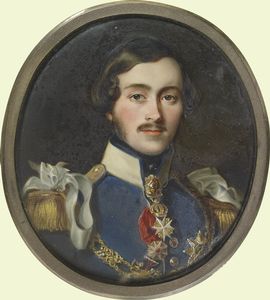
Lord of Ravenstein and Tonna, et cetera. 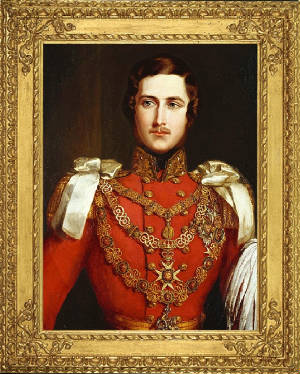 Prince Albert - Prince
Consort of Great Britain Prince Albert of Saxe-Coburg and Gotha (Francis Albert Augustus Charles Emmanuel;
later The Prince Consort; 26 August 1819 - 14 December 1861) was the husband of Queen Victoria of Great Britain and Ireland. He
was born in the Saxon duchy of Saxe-Coburg-Saalfeld, at the age of 20 he married his first cousin, Queen Victoria, with whom
he would ultimately have nine children. At first, Albert felt constrained by his position as consort, which did not confer
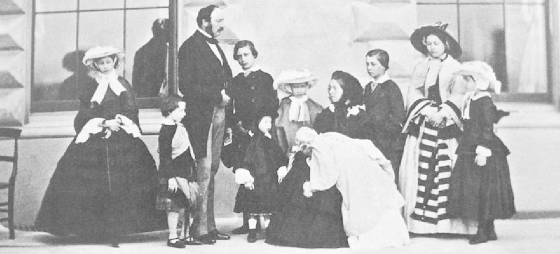
any power or duties upon him. Queen Victoria and Prince Albert with their Nine Children
Over time he adopted many public causes, such as educational reform and a worldwide abolition
of slavery, and took on the responsibilities of running the Queen's household, estates and office. He was heavily involved
with the organisation of the Great Exhibition of 1851. Albert aided in the development of Britain's constitutional monarchy
by persuading his wife to show less partisanship in her dealings with Parliament-although he actively disagreed with the interventionist
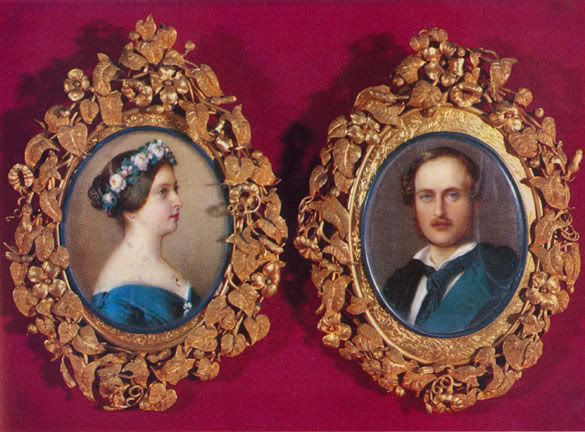
foreign policy pursued during Lord Palmerston's tenure as Foreign Secretary. Portraits
of Queen Victoria and Prince Albert the Prince Consort Prince Albert died at 10:50 p.m. on 14 December 1861 aged only 42 years old, in the Blue Room at Windsor Castle,
in the presence of the Queen and five of their nine children. The contemporary diagnosis was typhoid fever, but modern writers
have pointed out that Albert was ill for at least two years before his death, which may indicate that a chronic disease, such
as Crohn's disease, renal failure, or cancer, was the cause of death., plunging the Queen into a deep mourning that lasted
for the rest of her life. Upon Queen Victoria's death in 1901, their eldest son, Edward VII, succeeded as the first British
monarch of the Ducal line of Saxe-Coburg und Gotha of the Ernestine House of Wettin to which his father Prince Albert belonged.
|